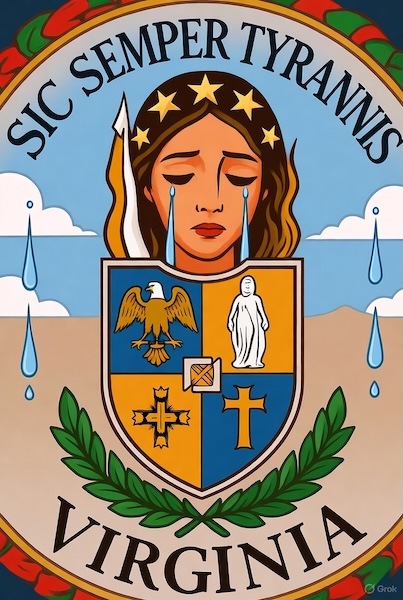
I live in this blighted state, dominated by the Swamp people and wanted to share some thoughts on the upcoming Virginia General Assembly session starting in January 2026, now that Democrats have solidified their control with a stronger majority in the House (64-36) alongside their Senate edge and the governorship flipping to Abigail Spanberger.
Based on recent legislative patterns, Democratic priorities, and ongoing proposals, here’s a realistic overview of what could unfold. While some items align closely with past Democratic agendas, others remain proposals facing potential hurdles like vetoes or legal challenges—though with full control, passage odds are higher. I’ve noted where these are confirmed pushes versus likely pursuits.
Gun Control: Democrats are poised to advance stricter measures, including bans on assault-style semi-automatic rifles and high-capacity magazines (over 10 rounds), building on 2025 bills like HB 1607. Expect renewed efforts to limit concealed carry reciprocity across states and enhance safe storage requirements, potentially with penalties for unsecured firearms leading to harm.
Right-to-Work Protections: Efforts to repeal Virginia’s right-to-work law, which prevents mandatory union dues, have circulated in prior sessions (e.g., HB 153). While not a top-line priority this year and allegedly opposed by incoming Gov. Spanberger, union-backed Democrats may still attempt to phase it out, potentially raising labor costs and local taxes via expanded collective bargaining.
Taxes: To fund priorities amid a projected surplus, look for new revenue streams like sales taxes on services (dry cleaning, repairs) and digital goods (streaming, apps). The 2026-2028 budget could extend or expand the earned income tax credit, but broader hikes on income or property might emerge if federal cuts loom.
Energy Costs: Rejoining the Regional Greenhouse Gas Initiative (RGGI) is a strong Democratic goal after a 2024 court ruling invalidated the exit; this cap-and-trade program would likely increase utility bills by $2-3 monthly on average but fund clean energy and flood resilience, with over $800 million raised previously. Spanberger has signaled support for rejoining, emphasizing its role in emissions reductions and revenue for community investments.
Transportation: Re-adopting California’s Advanced Clean Cars standards (ACC II) could mandate 35% of new 2026 model-year vehicles be electric, ramping to 100% by 2035—though Youngkin’s 2024 withdrawal means Democrats would need to override that via new legislation, facing pushback on infrastructure readiness. On I-95 between the Capital Beltway and Richmond, Spanberger has made clear she will not expand general-purpose lanes or add significant capacity; the Fredericksburg Express Lanes extension is complete and no further widening is budgeted. Any new funding will go to maintenance (bridge rehabs, ramp tweaks) and parallel transit or rail studies, leaving peak-hour congestion largely unchanged.
Elections & Gerrymandering: A proposed constitutional amendment (HJ6007) to allow redrawing congressional districts ahead of 2026 midterms has cleared initial votes; if approved again post-election and by voters in a spring referendum, it could shift Virginia’s 11 districts toward 8-9 Democratic-leaning ones (from the current 6-5 split), countering GOP gerrymanders elsewhere.
Education & Culture: With Democratic control, expect reinstatement of inclusive policies for transgender students, including access to bathrooms and sports matching gender identity, reversing Youngkin’s 2023 model policies that emphasized parental consent and biological sex. Broader pushes for LGBTQ+ protections in schools and expanded sex education are also likely.
Immigration: Moves toward sanctuary-state policies, such as limiting local cooperation with ICE detainers beyond serious crimes, could gain traction despite Youngkin’s prior bans on “sanctuary cities.” Recent ICE courthouse arrests have heightened Democratic calls to protect non-criminal immigrants, potentially tying state funding to compliance.
Criminal Justice: The “Second Look” bill, allowing those sentenced as youth or after 15 years (even for violent felonies) to petition for resentencing based on rehabilitation, returns for a fourth try after near-passes. It includes victim input but faces GOP resistance over public safety.
Oil, Gas, and Broader Energy Plans: Building on the Virginia Clean Economy Act (VCEA), which mandates 100% carbon-free electricity by 2050 and phases out fossil fuels like natural gas plants by 2045-2050, Democrats are likely to defend and expand clean energy mandates amid surging demand from data centers. This includes accelerating offshore wind (e.g., completing the Coastal Virginia Offshore Wind project by 2026) and solar buildouts, with 2026 targets requiring utilities like Dominion to hit 17-29% renewables or face penalties. Spanberger’s platform embraces an “all-of-the-above” approach with renewables, but includes natural gas for reliability during the transition—potentially approving peaker plants for peak demand while exploring hydrogen and small modular nuclear reactors. Restrictions on new oil and gas infrastructure could tighten, prioritizing efficiency rebates and grid upgrades to avoid over-reliance on fossil fuels, which critics say drive bill hikes; however, utilities may push back for balanced approvals to meet projected 6.5% annual energy growth without blackouts.
A Few More Possibilities: Beyond these, Democrats may prioritize codifying abortion rights via constitutional amendment (building on 2025 efforts), legalizing recreational marijuana sales (delayed from 2024), raising the minimum wage to $15/hour by 2028, and boosting Medicaid expansions or clean energy incentives. Budget fights could center on education funding and housing affordability, with surplus dollars targeted at flood mitigation and public transit.
Overall, this session shapes up as a progressive pivot, but outcomes will depend on bipartisan buy-in for amendments and Spanberger’s veto pen on the most divisive items. It’s a pivotal year for Virginia’s direction heading into national midterms.